
When I first developed patellar tendonitis, I was desperate. I had exceeded my tendon’s load tolerance through too much strength training combined with basketball, leading to a state where my knees hurt constantly. Like many of you, I tried everything. Doctors and physical therapists couldn’t solve it, so I turned to the research.
In the 15 years since I became a “patient turned expert,” I have reviewed over a thousand studies and helped more than 10,000 people navigate this injury. One of the first things people ask me is: “What stretches will fix this?”
Here is the honest truth: Stretching is an important piece of the puzzle, but for most people, it is Step 4 or Step 5 and not Step 1. In my experience, stretching provided me with mild, temporary relief at best when my injury was acute. However, once the injury healed, stretching became a powerful tool for maintenance and preventing a comeback.
If you are looking for relief, the goal of stretching isn’t to lengthen the tendon itself, but to reduce tension in the muscle-tendon unit. Research suggests that while static stretching affects muscle compliance, specific types of stretching (like ballistic) may be required to actually change tendon stiffness (Witvrouw et al., 2007).

Can Stretching Make Patellar Tendonitis Worse?
Yes, stretching can absolutely make your condition worse if timed poorly.
In my work with ambitious athletes and everyday clients, the most common mistake I see is stretching when the tendon is already irritated. If your tendon is currently flaring up (i.e., throbbing, warm, or sharp to the touch) aggressively pulling on it via a deep quad stretch can trigger a worse flare-up.
When to Wait
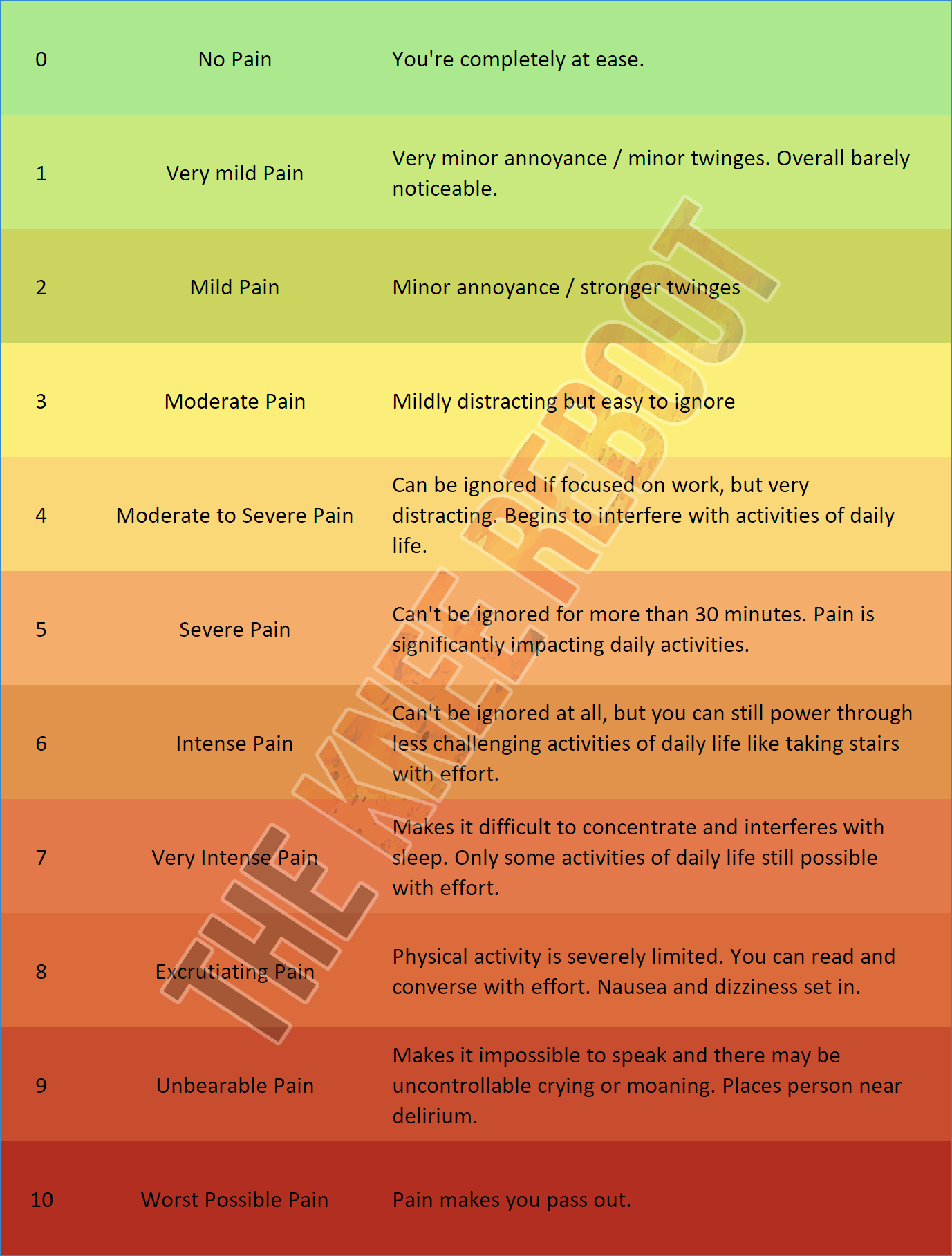
If your pain levels are high (above a 3/10), it is often better to wait. I advise clients to focus on calming the tendon down first, often through isometric holds or very slow strengthening exercises. As noted in a recent Cochrane review, strengthening exercises are the primary evidence-based treatment for this condition, whereas other modalities are secondary (Lopes et al., 2025).
When to Stretch
Stretching becomes beneficial once the tendon has strengthened and is no longer easily irritated. At this stage, stretching helps maintain the compliance of the muscle-tendon unit, which is crucial for absorbing energy during sports that involve the stretch-shortening cycle, like basketball or volleyball (Witvrouw et al., 2007).
Early wins in recovery often look like pain decreasing during the day or being able to drive for longer periods without stiffness—not necessarily touching your toes.
Stretching Rules for Patellar Tendonitis
Through helping thousands of “hopeless” cases improve their situation, I have developed a few non-negotiable rules for stretching.
Rule 1: The 3/10 Pain Limit
The stretch should never cause tendon irritation or exceed a 3 out of 10 on the pain scale. If you feel sharp pain at the point of the knee, you are likely compressing the irritated tissue. Back off.
Rule 2: If In Doubt, Leave It Out
If you aren’t sure if a stretch is helping or hurting, stop doing it for a few days. Recovery from patellar tendonitis is possible using tendon strengthening exercises without stretching at all. Stretching is a “nice to have” for some, not a “must have” for everyone.
Rule 3: Never Use It As Standalone Treatment
I never use stretching as a standalone treatment for tendonitis. It is okay for standalone maintenance once you are healthy, but it will not fix the pathology of a degenerated or overloaded tendon. Strengthening exercises that progressively load the tendon are required to improve clinical outcomes (Lopes et al., 2025).
SELF-CHECK: Rate your current knee pain. If it is above a 3/10 while resting or walking, skip deep stretching today and focus on isometrics.
Patellar Tendonitis Treatment Stretches
I have found that most people are too pressed for time to follow a complex regimen. Therefore, a stretching routine must be efficient. This routine focuses on the kinetic chain surrounding the knee, rather than just pulling on the knee itself.
Perform this routine after your body is warm (e.g., after a walk or a strengthening session).
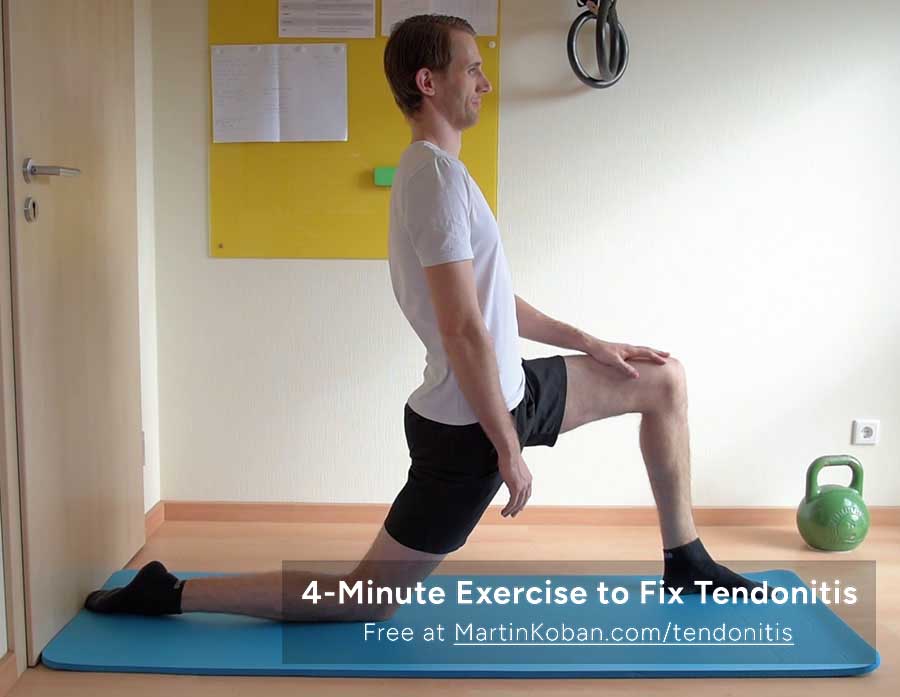
- Hip Flexor Lunge (Releases tension above the knee)
- Standing Quad Stretch (Mobilizes the primary pulling muscle – see further down)
- Calf Stretch (Improves landing mechanics – see further down)
- Hamstring Stretch (Balances the posterior chain – see further down)
Patellar Tendonitis Quad Stretch
The quadriceps attach directly to the patella. If they are tight, they can increase the tensile load on the tendon. However, traditional heel-to-butt stretches can compress an irritated tendon.
The Standing Variation (Safer for Beginners)
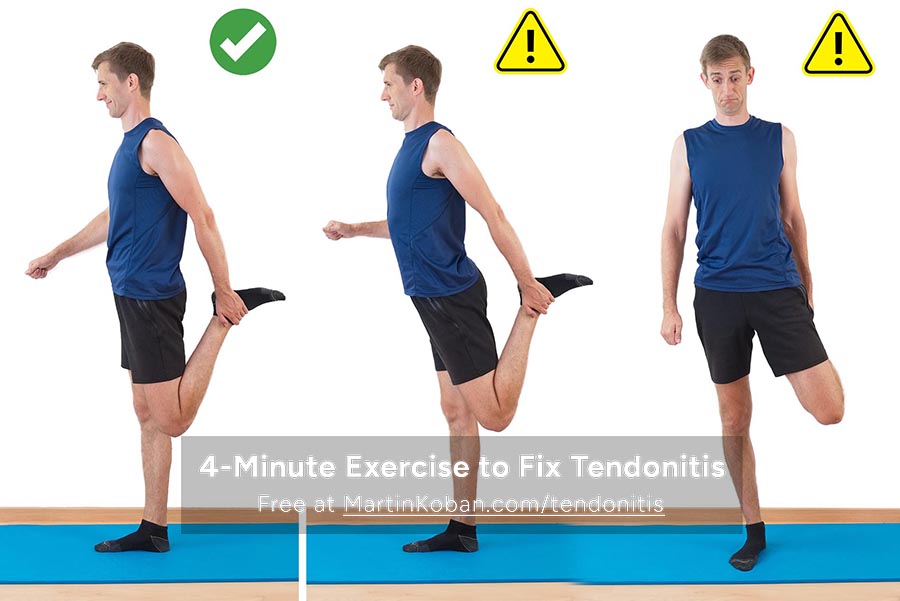
Stand on one leg (hold a wall for balance). Gently bring your heel toward your glute. Crucial Tip: Do not let your knee flare out to the side. Keep your knees close together and squeeze your glutes to push your hips forward. This lengthens the rectus femoris without excessive knee flexion.
The Couch Stretch (Advanced)
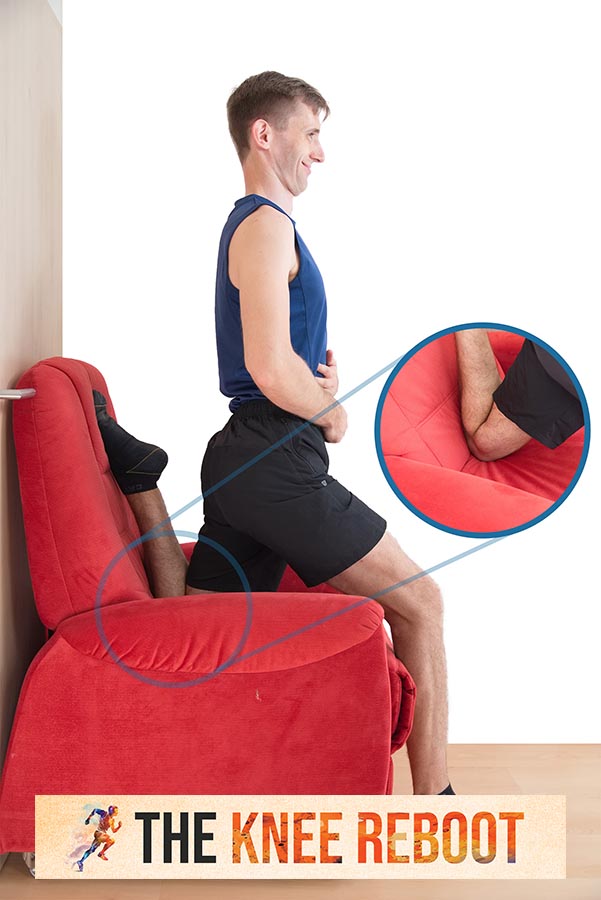
Only attempt this if you have low pain levels. Place your shin against a wall or couch cushion, knee on the floor. Squeeze your glute to drive the hip forward. This provides a deep release but places significant compressive load on the kneecap.
| Pain Level | Recommended Quad Stretch | Why? |
| High (4+/10) | None / Foam Rolling | Avoids compressing the irritated tendon. |
| Moderate (2-3/10) | Standing or Side-Lying | Allows control over knee flexion angle. |
| Low/Maintenance | Couch Stretch | Maximizes mobility when tissue tolerance is high. |
Hip Flexor Stretches for Jumper’s Knee
In my experience, tight hip flexors are a silent contributor to knee pain. They tip the pelvis forward (anterior tilt), which effectively “pre-loads” the quads and the patellar tendon.
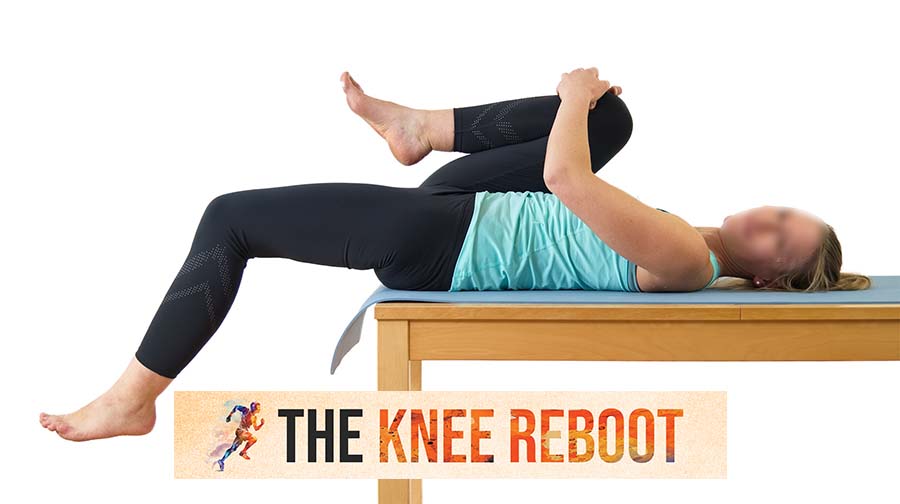
Gentle Hip Flexor Stretch
Use this to stretch your hip flexors without putting any pressure on your knee. Lie down on a table and pull both knees up to your chest. Keep your lower back flat on the table. Now let one knee drop down, but keep the thigh in line with your body. The knee should not drift to the outside. Let it drop and relax for 60 – 120 seconds.
Calf and Ankle Mobility Stretches for Patellar Tendon Pain
Ankle stiffness forces the knee to do more work. Biomechanical studies show that exercises involving landings (Tier 2 and Tier 3 loads) require significant shock absorption (Scattone Silva et al., 2023). If your ankles don’t bend (dorsiflex), your knees have to absorb that force abruptly.
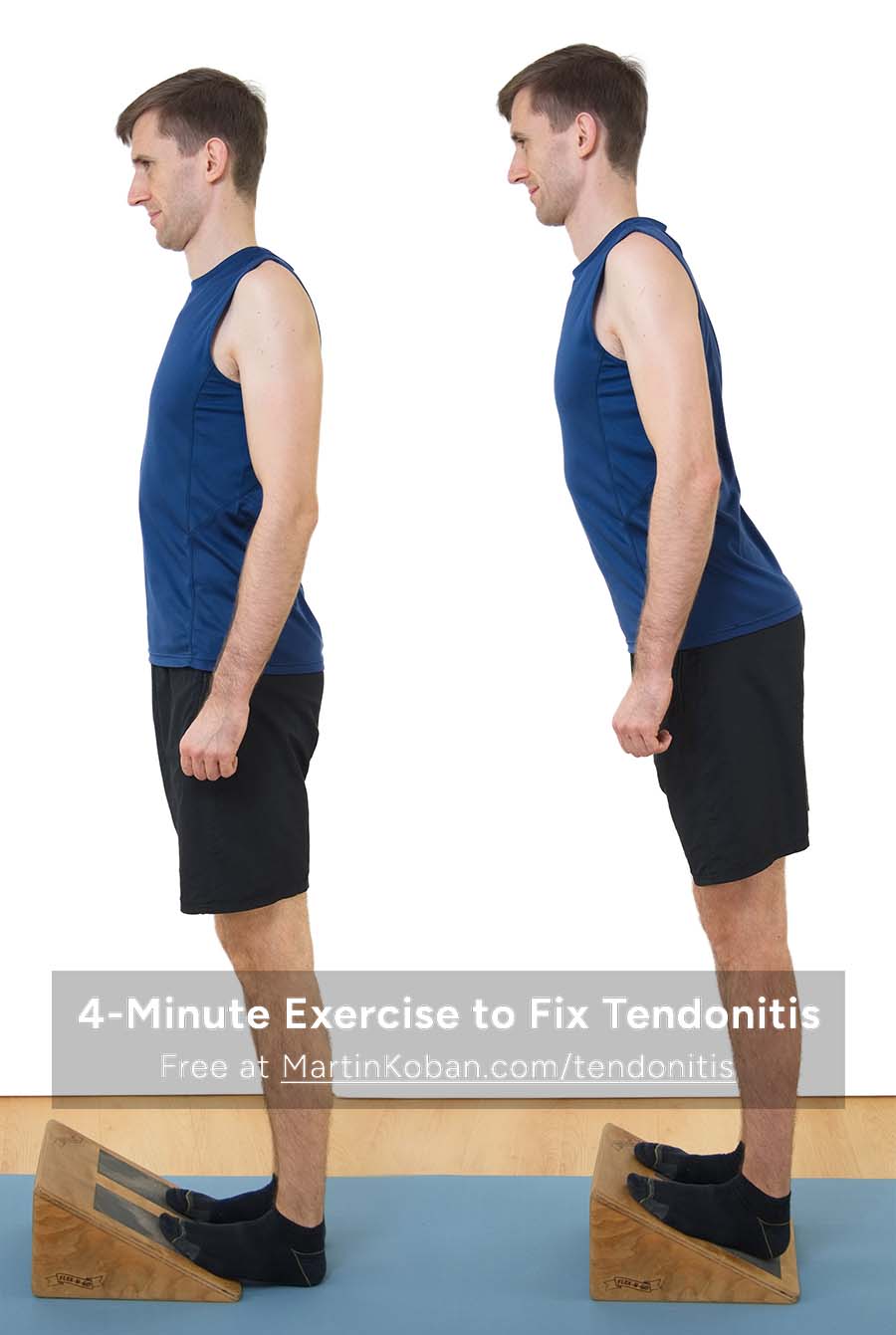
The simplest and most convenient way to stretch the calves is with a slanted board.
Hamstring Stretches for Patellar Tendon Pain
I often tell clients that while posterior chain flexibility is good for general health, it is rarely the primary driver of patellar tendonitis. However, tight hamstrings can force the quadriceps to work harder to extend the knee.
Research indicates that repetitive stretching can make hamstrings more compliant (Witvrouw et al., 2007). This compliance may improve overall biomechanics during running and jumping, which can remove undue stress from the tendon.
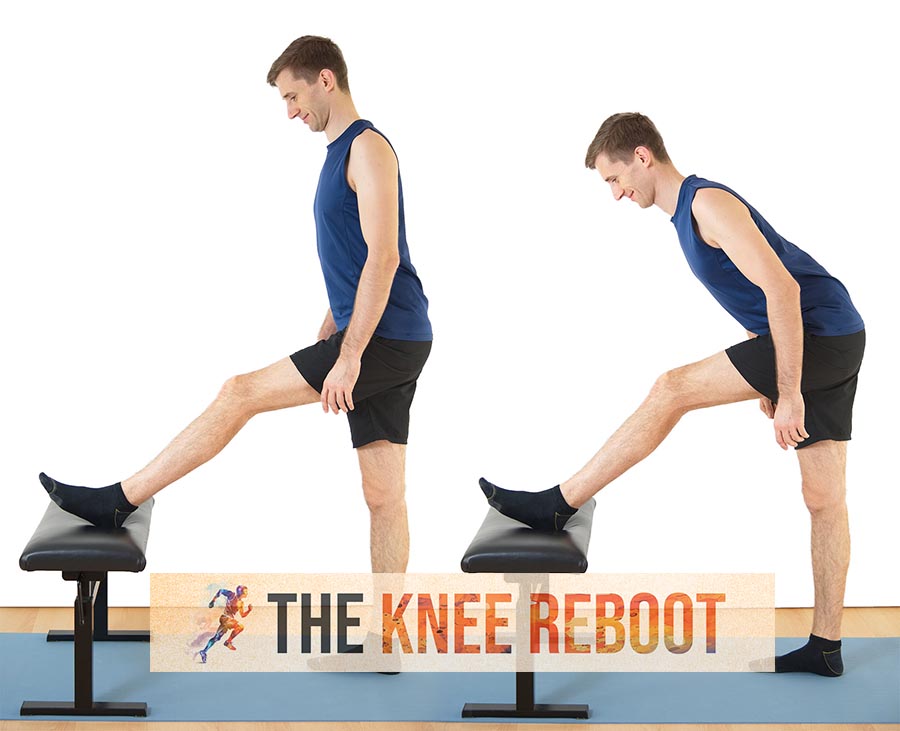
Hamstring Stretch
The traditional option is the classic hamstring stretch. There are many variations of this one. Find one you like and stick to it. You can do it standing or lying on your back. You could even do it with a partner.
Boot-Strapper: Hamstring Mobility Stretch
Another hamstring stretch for patellar tendonitis is the boot-strapper:
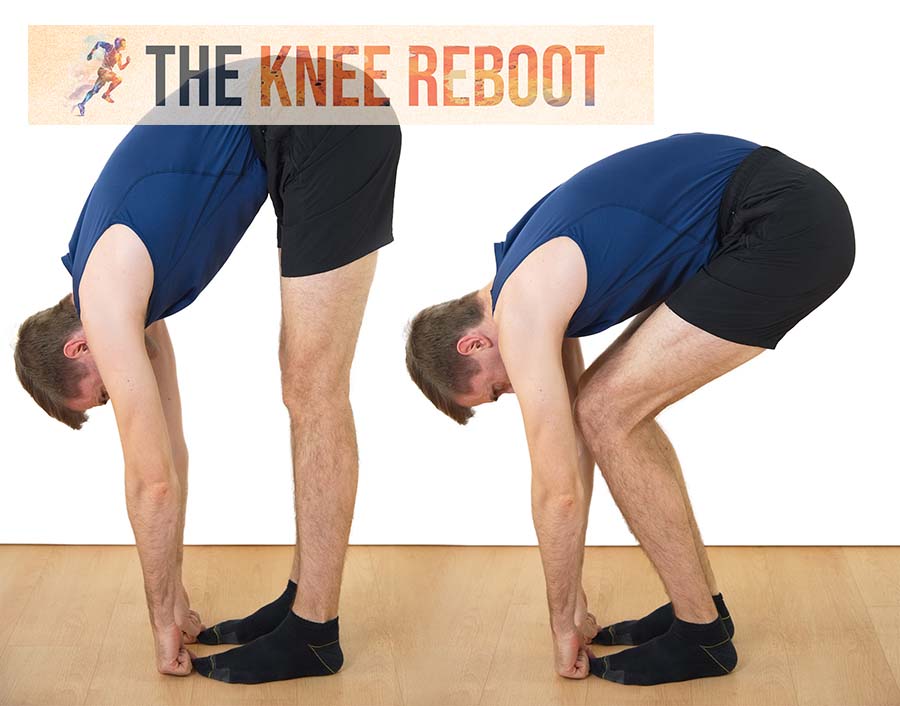
Keep your hands on the floor and extend your knees as you breathe out. Do 50 – 100 reps. Only do this if your tendon can tolerate it.
Patellar Tendonitis Stretches for Runners
Running is categorized as a “Tier 2” load, generating peak forces of roughly 4.8 times body weight (Scattone Silva et al., 2023). This is significant, which is why running is not safe during the beginning stages of rehab. During those times, focus on tendonitis exercise, like slow tendon loading as well as foam-rolling, to strengthen the tendon while relaxing the muscles. If you reintroduce running to early, you risk causing a setback.
Pre-Run: Dynamic Mobility
Do not do long static holds before running. Instead, perform leg swings (front-to-back and side-to-side) and walking lunges. This prepares the tendon for the “spring” action required in running. I also like to throw in a classic isometric squat for two sets of 45 seconds. You can also do this on a single-leg.
Post-Run: Static Cooldown
This is where you apply the static Quad and Calf stretches mentioned earlier. If pain spikes after a run, do not stretch immediately. Ice or rest, and wait until the irritation subsides. In these cases, your tendon is NOT ready for running and your rehab would go faster if you solely focused on tendon strengthening exercises.
Warm-Up Stretches and Mobility Before Squats, Jumps, and Leg Training
High-load activities like jump landings or cutting generate the highest tendon forces: up to 5.5x body weight or more (Scattone Silva et al., 2023).
Before these activities, you want to warm up the tendon without irritating it.
- Short Isometrics: A 30-second wall sit (mid-range).
- Bodyweight Box Squats: Control the descent.
- Dynamic Stretching: Butt-kicks and high knees (low intensity).
Ballistic stretching can increase tendon elasticity, which is vital for high-impact sports, but it should only be introduced once you have built a baseline of strength (Witvrouw et al., 2007).
Stretching Mistakes That Keep Patellar Tendonitis From Improving
Every story I hear is different, but the mistakes are often the same. With stretch, these often include:
- Stretching the Attachment Site: People often rub or pull on the painful bump below the kneecap. This aggravates the insertion point. Stretch the muscle belly (middle of the thigh), not the tendon.
- Ignoring Strength: Some people try to “stretch away” the pain for months. As stated in the Cochrane Review, there is uncertainty whether exercise reduces pain compared to no treatment unless it is the right kind of strengthening (Lopes et al., 2025). Stretching alone will not fix the load tolerance issue.
- Stretching Through Pain: If you are grimacing, you are doing too much.
- Stretching a weak tendon: If stretching causes irritation or a flare-up of pain, the tendon was too weak. Do tendon strengthening exercises for at least a month before trying stretching.
Daily Stretching Plan for Knee Tendonitis
This plan is for maintenance or for those with low-level pain (1-3/10).
- Morning: 2+ minutes. Calf stretch while brushing teeth.
- Mid-Day: 3 x 1 minute. Standing Quad Stretch (30 sec per side) to counteract sitting.
- Evening: 2 x 2 minutes. Couch stretch or wall quad stretch.
When to Scale Back: If you wake up with more stiffness than usual, or if your “early wins” (like driving comfort) start to regress, cut the stretching and focus purely on isometric strength until the baseline returns.
Ready to Fix Your Tendon Pain for Good?
Stretching is a helpful tool, but it’s only one part of the solution. To truly recover, you need a structured plan that builds your tendon’s strength without overloading it.
I have compiled the exact strategies I used to fix my own knees—and the knees of 10,000+ others—into a free email course. It breaks down the strengthening steps that actually move the needle.
5 Tendonitis Mistakes That Add Years to Your Recovery Time
See you in the course.

P.S. You’ll learn exactly how to progress from “I can’t walk without pain” to returning to your favorite sports safely.
Lopes, A.D., Rizzo, R.R.N., Hespanhol, L., Costa, L.O.P. and Kamper, S.J. (2025) 'Exercise for patellar tendinopathy', Cochrane Database of Systematic Reviews, Issue 5. Art. No.: CD013078.
Scattone Silva, R., Song, K., Hullfish, T.J., Sprague, A., Grävare Silbernagel, K. and Baxter, J.R. (2023) 'Patellar Tendon Load Progression during Rehabilitation Exercises: Implications for the Treatment of Patellar Tendon Injuries', Medicine & Science in Sports & Exercise, 56(3), pp. 545-552.
Witvrouw, E., Mahieu, N., Roosen, P. and McNair, P. (2007) 'The role of stretching in tendon injuries', British Journal of Sports Medicine, 41, pp. 224-226.


