
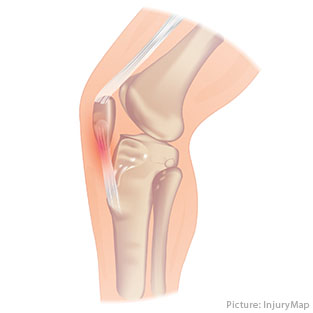
 If you’re feeling pain in the front of your knee, you might be wondering: Is this patellar tendonitis (“jumper’s knee”) — or something else entirely? Often it’s not easy to tell because several injuries cause pain in nearly the same spot, and getting the diagnosis wrong can mean months of frustration.
This page will guide you through the common symptoms, pain location, imaging, and comparisons with other knee injuries — but to learn how to confirm whether your pain really is tendonitis (and what to do next), keep reading.
Symptoms of Patellar Tendonitis (Jumper’s Knee)

With patellar tendonitis, the pain sits in the patellar tendon — usually right where it attaches to the kneecap (the lower pole of the patella). The pain can feel sharp and stabbing, but it may also show up as a dull ache. Sometimes it spreads along the tendon or down to where it connects to the shinbone, though that’s less common.
Another hallmark of jumper’s knee is delayed pain. You might finish your training feeling fine, only for the pain to set in hours later — sometimes not until the next day. This lag of 24 to 48 hours is one reason the condition feels so unpredictable and frustrating.
At first, pain usually increases in direct proportion to how hard you run, jump, or train. But as the injury progresses, that relationship can break down. You may start feeling severe pain even after very little activity, which is a sign the tendon has become more sensitive.
Because the symptoms can be confusing, many people make mistakes in treatment. I’ve been studying this injury since 2010 and have helped thousands recover — from everyday athletes to doctors and professionals. If you want to avoid the traps that hold most people back and see the strategies that actually work, I share them for free in my Tendonitis Insights course (link further down).
How Doctors Diagnose Patellar Tendonitis

Doctors typically diagnose patellar tendonitis through a combination of manual examination and, if needed, imaging tests like MRI or ultrasound. Your training history and choice of sport also play a role in narrowing things down.
For example, if you play jumping-heavy sports such as basketball or volleyball, tendonitis is a much more likely culprit — which is why it’s nicknamed “jumper’s knee.” In contrast, runners tend to develop it far less often.
Keep reading for a deeper look into the specific signs and tests that help confirm the diagnosis.
What Does Patellar Tendonitis Feel Like?
Patellar tendonitis often starts as a sharp twinge during activity, sometimes turning into a dull ache afterward. Many people notice it most when jumping, sprinting, or squatting, but here’s the catch: other knee conditions can feel almost the same in the first weeks.
The difference comes down to three specific signs, one of which you can check for at home in under a minute. To learn more and why so many people end up chasing the wrong rehab plan, see the full guide: What Does Patellar Tendonitis Feel Like?
👉 If your symptoms match, the next step is figuring out which stage of tendonitis you’re in. I explain how in the free Tendonitis Insights course, used by thousands to speed recovery.
Patellar Tendonitis Location of Pain

The location of pain is one of the biggest clues. With jumper’s knee, it’s usually right below the kneecap, along the patellar tendon itself (yellow circle). But here’s where many get it wrong: pressing the wrong area can make a different injury look like tendonitis.
To learn how to run the simple self-test that often reveals patellar tendonitis, and see a comparison table showing how it differs from PFPS, fat pad impingement, and other conditions, read the full guide: Patellar Tendonitis Location of Pain
Patellar Tendonitis vs Other Knee Conditions
Pain at the front of the knee can be patellar tendonitis, but it can just as easily come from PFPS (“runner’s knee”), chondromalacia, IT band syndrome, or meniscus issues. The symptoms overlap so much that even doctors sometimes need extra checks.
The key is learning the subtle differences in pain location and triggers. For example, tendonitis hurts directly in the tendon, while PFPS is usually felt behind the kneecap.
I’ve laid out the clearest comparisons, including diagrams and a full condition-by-condition breakdown, here: Patellar Tendonitis vs Other Knee Conditions.
Patellar Tendonitis MRI & Imaging Guide
Many athletes ask: Should I get an MRI to confirm tendonitis?
Patellar tendonitis is primarily diagnosed clinically. That means a skilled professional can usually confirm it without imaging. Still, MRI or ultrasound can help rule out other problems when symptoms don’t fit the classic pattern.

On MRI, tendonitis may show thickening or signal changes; on ultrasound, darker “hypoechoic” spots are common. But here’s the surprising part: imaging doesn’t always match pain levels. A tendon can look damaged on a scan but feel fine, or vice versa.
For examples, pros/cons of MRI vs ultrasound, and when imaging is worth it, see the full guide: Patellar Tendonitis MRI & Imaging Guide
When to Seek Medical Help
Most cases of tendonitis improve with the right strengthening and load management. But see a doctor if:
- Pain lasts more than two weeks despite rest.
- Pain changes location or spreads.
- There’s swelling, redness, or you can’t bear weight.
- Your knee locks, catches, or feels unstable.
If you’re unsure, it’s always better to get checked early — it can save you months of wrong treatment.
Next Steps: Moving Toward Recovery
Knowing the symptoms and diagnosis is only the beginning. The harder part is choosing the right recovery approach.
Still Not Sure If It’s Tendonitis? Here’s How to Finally Know — and Fix It
That’s why I created the free Tendonitis Insights course — to give you the key mistakes to avoid, the quick self-test that often reveals jumper’s knee, and the 4-minute exercise that helps tendons get stronger instead of weaker.
Thousands have used my method to feel better. You could be the next success story.


